April 02, 2012


Indonesia's Floating Paradise: The River Markets of South Kalimantan


Thousands of Indonesians travel to Thailand each year to see the renowned Damnoen Saduak Floating Market. Little do they know, there is a floating market closer to home, located in Banjarmasin, the capital of South Kalimantan. 

Early Morning ‘Fortune’ 

It was raining hard in the pre-dawn hours. The call for morning prayer had not been made yet. The city of Banjarmasin was still in deep slumber, but I was already up and ready by the side of the main road, waiting for any transport that could take me to the morning Kuin floating market. 

Having my previously arranged tour suddenly cancelled due to an insufficient number of guests to fill the quota, I was forced to make last-minute travel arrangements to the floating market. I was sleepy, soaked and disoriented. Looking at the empty road, I began to think that going to Thailand’s floating market is a better idea. At least the logistics in tourist-friendly Thailand would have been easier to arrange. 

Luckily for me, Indonesia is filled with friendly people who are always ready to lend a hand to others. 

Banjarmasin was deserted at dawn with no sign of taxis, ojeks or any other vehicles passing by, but an old man took pity to me. He helped me wake up a taxi driver, who was sleeping in his taxi, and asked him to take me to the Kuin Market Dock, where I would be able to rent a klotok (small traditional boat) to cruise around the floating market. 

The driver wasn’t thrilled to be woken up so early, but as Indonesians say, “You can’t and shouldn’t refuse rezeki [ fortune destined by God], especially that which comes in the morning.” So he drove me through the rain and darkness, all the way to the dock. 

Once I was there, I faced another problem. Where were the klotoks that I could rent? The rain must have already halted business for the day. 

Walking down the dock, I finally found a single boat. The captain, Utuh, suggested Rp 150,000 ($16.38) for the rental, which would include visits to some surrounding islands, but I haggled him down to Rp 100,000. It was fair enough for both of us. 

I hopped on and he immediately sailed along the Barito River. After a short ride, he stopped the boat in the middle of the Kuin River and asked me to wait for the floating market to emerge. Emerge? From where? There I was, clutching my umbrella tightly, my mind filled with expectations but my eyes weary with exhaustion. I gave into a quick nap. 

Emerging Market 

Soon after the call to morning prayer sounded, Utuh woke me up from my little nap. He told me the market was coming. “Coming” was indeed the right word. As I pulled myself out from the canopy, I saw several canoes carrying fruits, vegetables, and fresh goods, making their way to the center of the watery area. The petite canoes, locally known as jukungs, were overflowing with the vibrant colors — bananas, cucumber and spinach were , stacked in the front of the boat. The vendors were mostly women energetically steering their jukungs with wooden paddles. Their heads were covered in distinctive traditional headware, round hat made from bamboo. 

As the sun slowly rose, the activity at the Kuin floating market increased. Arriving from various small canals linked to the Kuin river, buyers started arriving, paddling to their desired vendors. Once they were close enough, the haggling take place. 

The radio in my klotok played some traditional Banjarese music as I sat outside watching the market with growing fascination. It was hard to believe this well-preserved tradition still exists in the era of shopping malls and on-line commerce. As the sun rose in the sky, new boats began arriving with eager tourists snapping away with their cameras. As the second largest floating market in the world, the exotic Kuin attracts many amateur photographers. 

With the morning hours passing by, the sellers eventually finished their business then steered back to the canals from where they came. Utuh said they were off to smaller floating markets in remote areas along the Barito or Kapuas rivers to do more business. Life is still centered along the rivers in Banjarmasin as most of the population lives along the river banks. 

After I finished sightseeing, it was time to have some breakfast — a floating breakfast. 

We glided slowly through the hordes of canoes as Utuh steered our boat to one particular klotok that was actually a floating cafe. As we got closer to his boat, the vendor tied our boat with a rope linked to his. I guess this “anchor” also functions as a security measure to prevent his clients from doing an eat-and-run. 

Packed in his half-meter wide boat, the man displayed a selection of dishes, from a heavy breakfast combo of rice wrapped in banana leaves to different kinds of traditional donuts, fried bananas, paes singkong and paes pisang (traditional banjar cakes of cassava or banana mix wrapped in a banana leaf). 

I decided to try a local delicacy so I went with rice with spicy egg. As soon as we ordered, the vendor used a wooden stick with a nail attached at its edge to harpoon our wrapped meal. He passed the food to us with the stick, too. This was a very clever technique as it would be hard to maneuver around the tiny boat to serve customers. For a three-course breakfast that included several cakes, we only paid Rp 25,000. 

Monkeying Around 

Our next stop was an island, Pulau Kembang, which is home to the lutung and l o ng-nose bekantan, both rare specie s of monkey. I didn’t have a good first impression of the island and it only went downhill as the visit continued. P lastic rubbish was scattered everywhere around the place and it seemed neglected and ghostly. 

Although it is endorsed as an official Taman Wisata (Tourism Park), the Rp 5,000 admission only gets you a view of monkeys hanging out by a gazebo. Also, the monkeys were rather aggressive, which made the recommendation that I buy peanuts to hand around seem suicidal. I rushed back to the boat in fear of my life. 

But the m orning got better after that and I enjoyed floating on the calm Barito River and se e ing the serenity of local life unfold. It was much nicer than fending off hostile monkeys. 

Historic Mosque 

Back on land, I followed Utuh’s suggestion of visiting the oldest mosque in South Kalimantan, which was located just a five-minute walk from the boat dock. 

The mosque was built by the first Muslim king of the Banjar Kingdom, Sultan Suriansyah, as a way of promoting Islam across the region. 

The design of the building was adapte d from the Demak Mosque in Central Java, with the roof styled in tiered layers following the principle of Meru, the sacred mountain that leads heaven and is often found in the architecture of religious buildings in Java and Bali. 

As with Demak, the entire building is made from wood and painted green, the color o f Islam. Adorned with intricate carvin g s of Banjarese flowers and plants, the mosque brings a sense of serenity and comfort. Added to the feeling is the fact that the wood construction absorbs heat, making the inside cooler. 

The laughter of local children playing football also found its way into the mosque. It made me calm; I felt safe in this house of God, which has survived for many centuries. 

Another five-minute walk brought me to the tomb of Sultan Suriansyah. The complex serves as the final resting place for the sultan, his queen and several others prominent Banjar Kingdom figures. The place has become a favorite for local and regional pilgrims. 

Though it was surely an interesting place to visit, a lack of signage and information made the mosque visit not as interesting or significant as it should have been. It would be nice if the government would invest in maintenance so that visitors could learn the history of this unique mosque. Remember that if you come, you must bring properly modest clothing as it is considered a sacred place by most Banjarese.


http://www.thejakartaglobe.com/lifeandtimes/indonesias-floating-paradise-the-river-markets-of-south-kalimantan/508350

February 23, 2012

Train Rides

I love travelling by train, some interesting trains that I have caught;  


The metro train in Dublin to Dalkey is very scenic, hill side views along the edge of the bay, only costs you a couple of euros. 


The Heathrow to Cardiff train is very easy and comfortable.


I've also caught a train Hanoi to Hue in Vietnam


Trains in Thailand north to Chiang Mai and south to Samui. 


The Ghan from Alice Springs to Melbourne


Jakarta to Bandung


Guangzhou to Hong Kong


Jakarta - Yogyakarta


And technically it is not a train, but a tram, but the Hong Kong Peak Tram ride is a classic.


February 16, 2012

Inside the World of the Baduy

Inside the World of the Baduy


Once, a woman of the Inner Baduy tribe told her grandson a story. On top of the earth, she said, women gave birth from their heads. On the bottom of the earth, they gave birth from their feet. But here at the center of the earth, in the forested Kendang highlands of West Java’s Banten Province, babies came from their mother’s bellies.

Young Kodo thought it was a silly story. There was no such thing as the “top” or “bottom” of the world.

Many years later, on a September night filled with the screech of cicadas, Kodo sits on the floor of a thatched Outer Baduy home. Beneath the once-white cloth he wears wound around his head, his face is alight with interest, his eyes intent on the atlas lying open in the center of an unlikely circle of people: several his fellow Inner Baduy, their Outer Baduy hosts, myself and two other visitors.

The owner of the house, Jakam, is explaining that the earth revolves around the sun. Kodo and his compatriots, taking this in stride, have a few follow-up questions for us.

Why is your skin white and ours darker? How does that camera work? And how big is the Internet?

An Unlikely World

There are not many places in the world where this type of exchange is even remotely possible, but the Baduy — or most of them — have steadfastly rejected modern conveniences and knowledge in accordance with the ways of their ancestors. The extremely conservative Inner Baduy live in a small, sacred area that foreigners are not permitted to enter and their mystical leaders, the Pu’un, are not allowed to leave. The Outer Baduy, slightly more lax when it comes to things like modern clothing and cellphones, live in villages that dot the hills around this inner sanctum in a protective buffer zone.

It is all the more incredible considering that the Baduy live within walking distance of the sprawling, smoking megacity that is Jakarta.

Walking distance for the Inner Baduy, that is. Gas-powered vehicles are off-limits, but they still go into the city on occasion to sell honey they have harvested or palm-sap sugar they have made. The bumpy, 120-kilometer trek — drivable in about six hours — takes them about three days. Wearing shoes would also violate their animist religion, known as Sunda Wiwitan, so they walk barefoot.

Just how sturdy their feet are becomes clear the next day as Kodo and his cousins Dede, Carakin and Sapri lead us on a walk through the highlands. Not a single one of them falters as we trek over high passes and through cool, wooded areas to see a bridge that Vita Ardiyana describes as an “icon” of their people.

Vita, a young woman who grew up just outside Baduy territory, organized our tour. She speaks Sundanese, a modern form of the Baduy’s ancient dialect that is close enough for her to be understood.

Every month or two, depending on demand, she’ll arrange trips from Jakarta for people to spend a night in an Outer Baduy village.

“You will take showers and swim in the river with the community,” she told us in an e-mail before our trip that also instructed us to bring drinking water, a flashlight, a raincoat and other basic necessities.

As for things to leave behind, she wrote: “The attitudes of an ignorant and selfish city dweller.”

About halfway to our destination, we encounter someone well-known to Vita: Aya Mursit, an Outer Baduy who acts as a liaison with the local government and the Muslim Sundanese who inhabit the villages that border Baduy land.

Hard Work

No community remains as unspoiled as the Baduy without deliberate intention, and talking to Aya Mursit, it is clear that it would be a grave mistake to underestimate his people because of their simple lifestyle. They are able to live the way they do in this modern world — without paying taxes to the government, with no deeds or titles to their land, refraining from formal education for their children — because they have some serious diplomatic talent.

To appease outside pressure, for example, they once built a mosque on their land. They didn’t use it, but it threw government envoys off the scent. When census takers pushed for access, the Baduy helpfully gave them a detailed list of answers they had compiled themselves. On the new e-KTP electronic identity cards that all Indonesians are required by law to possess, their religion was not listed, so the Baduy have left that field blank.

Each year, the government doggedly tries to give them money to build a school. Each year, they decline, seeing it as an insidious erosion of their culture. “If the children go to school, it’s just the same as the outside world,” Aya Mursit says through Vita. “They would be exposed to different values, and risk becoming greedy.

“A lack of an education isn’t the same thing as a lack of intelligence.”

The Baduy have long been considered a source of wisdom and magical power by other Indonesians. Many have sought an audience with the spiritual Pu’un leaders over the years, but they are picky about who they will see. Former President Sukarno, who granted them government protection, sometimes consulted with them. When his successor Suharto tried to visit in his helicopter, the Pu’un sent an envoy.

The Good Life

By and large, the Baduy are walking advertisements for clean living. Their skin is glowing and unblemished, their physiques are the type that gyms plaster on billboards. Their society has essentially zero crime.

But Baduy is not utopia.

One of Jakam’s neighbors, a young mother, was bitten by a snake some months ago. She was treated by a traditional healer but received no modern medicine and died horribly over three days.

A 2006 study by the Bina Karta Lestari Foundation, an NGO that works toward sustainable development, found that the government considers the Baduy to be living in poverty. Using income, education level, sanitation, access to electricity and savings as indicators, they are indeed. But measuring access to adequate clothing, food and housing, they do not lack for anything.

So how long can they hold out and keep their way of life intact? Considering their long history of sustainable practices, the answer would seem to be “indefinitely” — if they are left to their own devices.

But as we continue our trip, there is more evidence of encroaching modernity. Politicians’ campaign signs crop up even in this remote area. A few cement pilings are in place, presumably the vanguard of a modern bridge over a river.

But that’s not the bridge they brought us to see. Our destination comes into view, and they smile at our gasps of astonishment.

The bridge is a wild tangle of roots that have naturally twined together across a stretch of rocky stream.

It is equal parts mossy and smooth, held up, at least for now, by an ingenious blend of old and new.

February 06, 2012

Child Worker (Busking) in Jakarta

While you read this, maybe your children are playing with their friends or getting some after-school tutoring to improve their grades. But for 10-year-old Bagus, his extracurricular activity involves jumping from bus to bus, singing the latest song he can remember while plucking along on his ukulele, hoping to receive some coins for his effort. My Jakarta ran into Bagus on a Kopaja bus while traveling from Slipi to Grogol, We asked him how he felt being a busker, what he did with the money he earned and his hopes for the future. While most children dream of being an astronaut or a celebrity, all Bagus dreams of is a steady job in an office.

When did you start working as a pengamen (busker)?

I don’t remember exactly when, but I think it might have been around when I was still 7.

Do you go to school?

Yes, I’m in the second grade, but I don’t want to tell you where I go to school [smiles].

What’s the matter, don’t your teachers and friends know that you are a busker?

Yes, my teachers know, but they never say anything about it at all. But I never let my friends know that I am a pengamen on buses.

Why is that, do you feel embarrassed?

Yes, nobody wants to do this for a living. Deep down in my heart I feel really embarrassed having to sing in buses and ask for money. But there’s no other choice. Having a side job that I wouldn’t be embarrassed about would be a luxury. All that matters is that the job pays.

What do your parents think about you singing on buses for money?

They both know that I’m a busker, but understanding our situation, they say that the decision is up to me whether I want to busk or not.

How long do you sing every day?

After school ends at about 4:30 p.m to 9 p.m.

So how do you make time to study?

I study and do my homework in the morning.

What do your parents do for a living?

My dad is a tukang parkir [parking attendant] and my mom takes in laundry from other people. I also have two younger brothers and sisters.

Do your parents ask for your money?

Never. They never ask how much I earn or how I use the money. As long as they know I’m not using it for something bad. I consider it my allowance.

How much can you make a day?

Around Rp 20,000 [$2]. Most people will give me Rp 2,000, but once I got Rp 50,000 from an old auntie. Sometimes I can only make Rp 10,000 a day. I ride from Slipi Kemanggisan to Grogol and from Grogol back to Slipi Kemanggisan again. This is my only route.

And how do you spend your money?

I save all of my money. I plan to use it when my school has its annual trip later. But sometimes I use my money to buy some Indomie [instant noodles]. I really love eating instant noodles [laughs].

Do you smoke?

No, I am afraid to smoke, I don’t think that my throat can hold it. I’m afraid that I will cough uncontrollably if I do.

Great to hear that, but does that mean you will smoke when you are strong enough?

Mmm, I don’t think so. I am pretty afraid to smoke [laughs].

But you’re not afraid of jumping from bus to bus?

Not at all. I am used to doing that.

What about preman [thugs], do any of them ever come and take your money?

Luckily no, I never have any of them asking for my money, but I get scolded a lot by the bus drivers. I don’t really know why they get so angry at me, but I am really afraid when they do.

And do you have somebody to protect and organize you?

No, I don’t belong to any groups or anything like that. I am doing this alone.

When you think about the future, what is your dream?

I want to work in an office.

I notice that you aren’t wearing any sandals. Where are your sandals?

I lost them a few weeks ago [smiles], but I don’t want to buy another pair. It’s too expensive and it’s better for me to save my money.

Bagus was talking to Edison Lestari on a Kopaja 88 from Slipi to Grogol.
source

January 31, 2012

Mountain hiking in Indonesia

Indonesian Hiking in the Bag
Catriona Richards | January 30, 2012


For anyone looking for a challenge in the New Year, here’s a record to beat: British hiker Daniel Quinn climbed 14 mountains in Indonesia last year, bringing his total number of conquered peaks to 49 since he arrived here three years ago — and that’s not including the 21 hills, volcanoes and other peaks he attempted along the way. His motivation? To upload information on Indonesia’s lesser-known hiking spots to the Web site Gunung Bagging (gunungbagging.com), started by Quinn and fellow hiker Andy Dean in 2009.

The name comes from the century-old British tradition of “mountain bagging” (gunung is the Indonesian word for mountain), whereby hikers challenge one another to conquer a checklist of peaks categorized by topographic prominence. It is called “bagging” because each peak conquered is another one “in the bag” for the hiker.

January 30, 2012

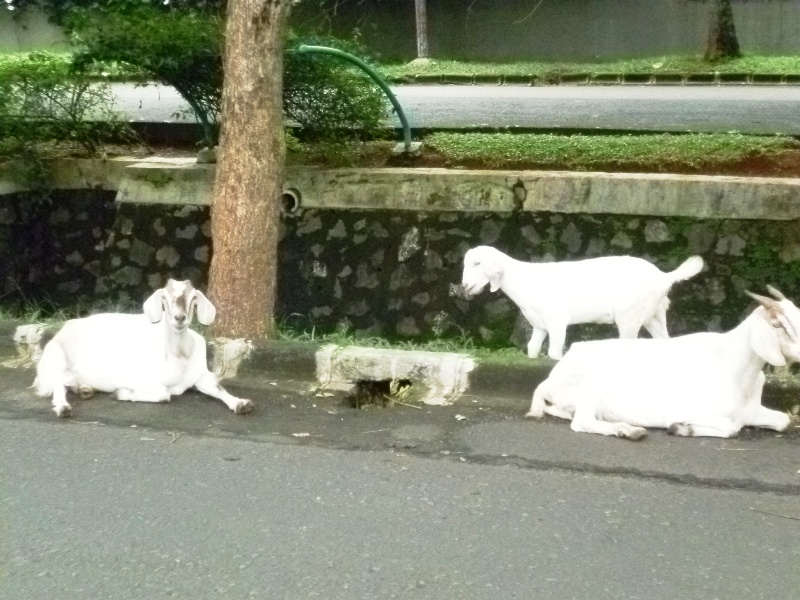
One can often see random herds of goats wandering around in Jakarta, sooner or later they're destined for someone's dinner.


January 24, 2012

Gong Xi Fa Chai or Happy Chinese New Year


The Chinese Lunar Dragon Year starts on Jan. 23, 2012.

(Photo: REUTERS / China Daily)

Here is a roundup of the superstitions surrounding the Chinese New Year:

1. No Cleaning - The household has to be thoroughly cleaned before the New Year's day because it is believed that cleaning sweeps away bad luck from the last year. However, all cleaning equipment should be put away before the New Year's Eve so that good luck is not swept away. Even though sweeping is allowed after the first day of a New Year, the garbage and dust shouldn't be carried through the front door, as it may result in death or estrangement of a family member.

2. No Ghost Stories - According to Chinese beliefs, what happens on the New Year's Eve sets a precedent for the rest of the year. Foul language and unlucky words are a taboo on the first day of the New Year. Since ghost stories essentially involve mentions of death, children as well as elders are not allowed to tell stories related to spirits, zombies or the undead.

3. No Washing Hair - Though you are encouraged to get a hair-cut on the first day, you're not supposed to wash your hair to ensure that good luck is not washed away.

4. No Books - Book stores remain closed on the New Year's Eve as buying books is not allowed. The reason stems from the fact that "book" is a homonym for "lose" in Cantonese. However, apparently, there is no restriction on reading.

5. No Shoes - Shoe shopping is restricted on the first day because "shoes" is a homonym for "rough" in Cantonese.

6. No Crying - Crying is also a strict no-no on New Year's Eve which is why children are spared from spanking or punishments on the first day.

7. No Sitting in Bedroom - It is unlucky to meet anyone in their bedroom on the New Year's Eve, which is the reason why everyone, including infants, elderly and even those who are sick, are made to dress up and sit in the living room.

8. No Sharp Objects - Handling sharp objects is considered bad omen on the first day of the New Year, as they may "cut off" good fortune. It is recommended to put away knives and scissors the previous day.

9. Red is Good - Bright red clothes, decorations and ornaments are highly recommended for the Chinese New Year. Children receive money in red paper envelopes from parents who wish them a healthy and happy New Year. Red paper-cuts and couplets with popular themes of "good fortune" or "happiness," are used to decorate the household.

10. Songbirds are Good - The first person you meet on the New Year's eve holds great significance on how lucky you would be throughout the year. It is considered lucky to see or hear songbirds, red-colored birds or swallows on New Year's Eve.

January 18, 2012

Street Jockeys - How to beat the traffic


Though many people consider Jakarta’s traffic a necessary evil, people like Martini look forward to their daily commute. For the past 13 years, Martini has made a living helping drivers meet the city’s ‘three-in-one’ rule that requires private vehicles to have at least three people to access some major roads during rush hour.

As a joki, or jockey, every morning and afternoon Martini heads to the Plaza Semanggi area and helps office workers to work or home by hopping a ride with them. The job is illegal and Martini has been arrested twice, but she insists the three-in-one jockeys are providing a valuable service, not disturbing public order. In any case, the former maid has no intention 
of leaving her post, unless it’s to hasten someone’s commute while making some small talk along the way.

How much do you get paid for being a three-in-one jockey?

I get Rp 10,000 [$1.10] to ride from Plaza Semanggi to Ratu Plaza and Rp 20,000 if the driver wants me to stay until Blok M. Sometimes I also go back from Blok M to Monas [the National Monument] for another Rp 20,000. You actually get paid for having a free ride around Jakarta.

How many rides do you take in a day and how much do you earn?

I arrive early at my station around the Semanggi area on Jalan Prof. Dr. Satrio, or as people call it, Casablanca. In the early three-in-one round, between 7 a.m. and 10 a.m., I can get two cars at most. Later, during my afternoon round from 5 p.m. to 9 p.m., I can get up to four drivers in need of my service. So on average I usually make Rp 40,000 to Rp 80,000 a day. Definitely not a bad way to earn extra cash for my family.

Is this the only job you have?

Yes. I need the extra money for my family. I have three children and my previous job as a maid wasn’t able to put enough food on the table. So when my younger sister asked me to join her out here doing this in 1999, me and my husband definitely jumped at the opportunity with no hesitation.

You know that working as a three-in-one jockey is illegal, right? Have you been arrested?

Sure, I got arrested twice last year by public order officers. They said I was violating local laws and was therefore disturbing public order. They made a record of my identity and took me to a shelter and locked me in there for the whole day.

I felt lucky because I heard another jockey got locked up there for a week, maybe because he had been arrested a number of times before.

On one memorable occasion, a traffic police officer stopped the car I was in. The officer asked the driver to open the side window and told me to get out. He threatened to turn me over to the public order officers if I didn’t admit that I was a jockey. I was afraid so I admitted it and the officer let me go while the driver got a ticket.

Knowing the consequences, why you still do it?

I know that my job is illegal, but I have never understood why the government thinks that we disturb public order. Drivers need us to use the major streets after work. Without us, lots of drivers would have to take long detours to get home, and that’s before even mentioning the traffic. Besides, the money I get from being a jockey helps my family survive in Jakarta, and is better than the other jobs that people like me usually do. We never chose to be poor, and the government hasn’t done anything to help us survive or make our lives better. So we take any opportunity that presents itself.

It seems like you have met lots of different kinds of people in your line of work. Have you ever met any ‘naughty’ drivers?

I haven’t met anyone who’s done anything indecent. Most of them are office workers who drive alone. Many of them like to make small talk with me. They ask me where I live and how many kids I have. One or two have even shared with me problems they are having with their work or family. But there are times when it’s just quiet in the car.

Do you ever get a good tip for just being nice to a driver?

Some nice drivers have paid me more than the usual rate. Others sometimes pay more because they’ve just gotten a big bonus or promotion at work.

Martini was talking to Carlos Situmeang.
http://www.thejakartaglobe.com/myjakarta/my-jakarta-martini-three-in-one-jockey/491081

September 19, 2011

Jakartans protesting against Street Monkey Abuse (Topeng Monyet)


Jakarta Animal Aid activists protest the treatment of monkeys in ‘topeng monyet’ shows during a demonstration at the Hotel Indonesia traffic circle in Jakarta on Sunday. (Antara Photo)

June 30, 2011

GWK : Garuda Wisnu Kencana (Huge Balinese Temple)

The beautiful and serene park, overlooking Jimbaran Bay, was originally meant to be the best cultural park in Indonesia, and maybe, one day, the world.


The 100 or so visitors milling around the 20-hectare Garuda Winsu Kencana cultural park in Jimbaran looked small in comparison to their surroundings. “It’s like visiting a cemetery,” said a young girl watching the sunset from the park, which sits on a hill south of Denpasar.

But now it is just another remnant of the New Order regime, part of an ambition to build world-class landmarks to compete with iconic structures like the Statue of Liberty in New York. Under the auspices of Soeharto, local artist I Nyoman Nuarta was commissioned to create a huge statue of Wisnu, the god of creation, sitting on Garuda, the mythical bird that carries him, with a final height greater than that of the Statue of Liberty. The project was started in 1996-7 and came to an abrupt halt on the 14th of May 1998 when the Rp collapsed along with the government.

The park was also to be equipped with a performance center with 7,500 seats, and ampitheather, a street theater, galleries, restaurants and other artistic attractions. Problems began to emerge almost as soon as construction started in 1997, with the budget ballooning to hundreds of billions of rupiah.

The park was initially the idea of the Garuda Wisnu Kencana Foundation, a grouping that included then minister of tourism and telecommunications Joop Ave, then mining and energy minister IB Sudjana, along with Nuarta and several other influential individuals and businessmen close to Soeharto.

It was to be built in the rocky and hilly area of Jimbaran, which present new logistical problems. The hills had to be cut flat to create the area required for the statue, which is still not finished today. Only the head and torso of Wisnu have been completed.

Land clearing was also an early problem. A 250-hectare plot of land, 100 hectares of which belonged to Badung regency, and the rest to residents, was required. Ten years later, there are still disputes over the matter.

“The clearing program with the local residents has not yet been solved properly,” said Anak Agung Ngurah Rai Riauadi, the park’s public relations manager.
Management of the park’s construction was not effective because so many people shared their ideas and wanted to see them put in place, “which were of course very difficult to accommodate,” he added.

The monetary, social and political crises between l997 and l998 worsened the situation. The fall of the Soeharto administration badly affected the project badly. Today, only 20 percent of the original project has been completed, and construction was halted entirely in September 2004.

Only a few years ago, President Susilo Bambang Yudhoyono promised to find investors to continue the project. “I promise to you that we will finish the project. It is the pride of the nation,” the President said in a speech. Nothing has happened since then.

I Made Mangku Pastika, former head of the Bali Police, was then appointed chairman of the foundation, while Edi Sukamto, owner of the Kuta Galeria Shopping center, was made the park’s director. “We will continue building the park in May 2008 to commemorate National Awakening Day,” said Mangku Pastika.

However, money will always be a lingering problem for the project. Only a very few investors are eager to invest in cultural projects.

June 14, 2011

The Use of Shoes Made in Indonesia Campaign


Bandung. Some civil servants in West Java are welcoming a proposal barring foreign-brand shoes at work — even if the provincial governor floored others by proposing push-ups as a penalty for defying the rule.


The plan, set to take effect on July 1, was meant to encourage the use of locally made footwear at government offices, based on a 2009 presidential decree promoting domestic products.

“I am [not afraid of the] sanctions that come with the rule because I already use locally made shoes every day. I have three pairs,” said Nana Adnan, secretary of the province’s animal husbandry office.

“There are many upsides to the policy — helping entrepreneurs, encouraging purchases just right for civil servants’ pockets,” he said. “And quality-wise, they are not inferior to imported products.”

Ade Sukarsah, employed at the provincial headquarters in Bandung, also said he was in the habit of going to work in plain-toes from Cibaduyut — a shoe-producing subdistrict.

“I don’t have many [foreign-label] shoes, maybe only two pairs,” he said on Saturday, a day after the proposal was announced.

“But if it’s for work, I only wear shoes made in the country,” the officer added.

West Java Governor Ahmad Heryawan had said on Friday that routine shoe checks would be conducted at government offices once the plan was implemented to ensure that the thousands of provincial-level employees would abide by the new policy.

The newly launched campaign was dubbed “The Use of Shoes Made in Indonesia.”

But the exact punishment for violating the rule had yet to be worked out, he said.

“The penalty can take various forms, including push-ups,” Heryawan said. “What is important is that there will be sanctions.

“This way, we are asking all people, especially civil servants, to side with the people” who work in local shoe manufacturing, the governor had said.

He said it would be up to officers-in-charge to ensure that their employees were toeing the line, adding that checking shoe brands would be “easy.”

However, Heryawan said district- and municipality-level officers will not be required — but encouraged — to follow the rule.

Ali Rahman Sidik, a cobbler in Cibaduyut, said he supported the initiative, but lamented that the government could have helped the industry more by specifying shoemaking districts where civil servants could buy shoes.

“I expect revenues [for Cibaduyut producers] to rise by around 25 percent [with the new rule],” he said.

“But if our subdistrict had been specifically mentioned in the circular as a place to support, revenues could rise by up to 75 percent,” Ali added.

Cibaduyut has 460 shoemaking businesses which produce an average of 4 million pairs of shoes a year and employ around 3,500 workers.

The shoemaker also said he hoped the same policy would be implemented at schools in the province and nationwide because this could boost the domestic shoe industry further.

May 22, 2011

Jakarta Animal Aid Network


New story in the news about Jakarta's monkey's.


SBS Dateline | Monkey Business

Posted by Administrator on 5/02/11 • Categorized as Jaan News,JAAN on Media

Source : SBS Dateline | Monkey Business

Link : http://www.sbs.com.au/dateline/story/transcript/id/601091/n/Monkey-Business

There is a common sight on the streets of Jakarta, trained monkeys who beg for food for their often impoverished handlers. It is a trade that seems harmless enough until you realise that the primates were not long ago swinging free in the jungles of Sumatra. David O’Shea has been examining the monkey business that has animal rights activists up in arms.


REPORTER: David O’Shea


It is a new day in the Indonesian capital and for millions of people struggling to eke out a living here, it is back to the daily grind. In the procession of human commuters this long-tailed macaque is off to work as well.

Born wild in the jungles of Sumatra, she is now forced to beg by the side of the road. Her handler, who makes her wear a doll’s mask, targets the areas with the worst traffic jams, and then waits for passing motorists to give money. There is little reward for effort in this business, so far only a mandarin.

REPORTER (Translation): No one’s giving you any money.

HANDLER (Translation): I have to be patient when it is like this.


REPORTER (Translation): Is it usually like this?

HANDLER (Translation): Yes it is but one or two people are sure to give me something.


Not far away, another long-tailed macaque is getting ready for work. To get there, Atun and her handlers have to dice with death on this chaotic streets. Atun is not a roadside beggar, but instead, works the neighbourhoods performing for children. She is reluctant to get started though, and needs to be egged on with a yank on the chain.


FEMKE DEN HAAS, JAKARTA ANIMAL AID NETWORK: In Indonesia, the attitude to animals in general is that you can do anything with them that you want, what life is there for us to use.


Femke Den Haas is from the Jakarta Animal Aid Network, she is campaigning to have the macaques listed as endangered and to stop them being used in this way.


FEMKE DEN HAAS: Macaques are just like great apes. – they are self-aware and they are highly intelligent and social. We do not have to look at the data on are they endangered or not. Just for ethical reasons, they should not be used on the street and going through so much cruelty. They should be living in the wild.


The whole dancing monkey’s performance is a wrong type of education. It is showing children that it is OK to exploit animals, to beat animals, to put them in chains and to use them as a toy. They are being used as a puppet. These monkeys are so frightened that they would do anything their owners ask them. You see their frustration – sometimes they are biting themselves. Children think that is funny – they say look they are biting themselves because they see them as puppets. They never get any education that this is a living being – they used to live in a family and has feelings or nothing.


Today’s performance finishes early because a link in the chain has broken and they do not want to risk her escaping.

REPORTER (Translation): Is there a danger that she will bite someone?

HANDLER (Translation): Yes, when she is not chained up she bites a lot of kids. It’s tiring work, we are out in the heat and we earn at most Rp 10,000. We go home and spend it and do the same again the next day. It’s like this every day.

They earn only a little over a dollar a day but the boys say they do not have other options. They are both orphans and this is the only life they know. They have been working with monkeys since they were just three years old.

HANDLER (Translation): We have no parents, so we earn money for food, now we are grown up we still work with the monkey. We earn Rp 1000 or 2000 so we can eat.


They tell me that Atun is like an old friend.


HANDLER (Translation): We played together as kids and now we are grown up, we have never changed monkeys, we always work with this one – she’s our mate, a real mate we are a family.


Not all monkeys there are as lucky as Atun. Femke Den Haas tells me that the Jakarta Animal Aid Network is desperate to stop street kids using monkeys to beg. And this means stopping those people who prey on the street children by renting them the trained monkeys as begging props.


FEMKE DEN HAAS: The children have to pay a certain amount of money each day to the owner of the monkey. The owner is just this guy that keeps monkeys in poor conditions next to his house in different locations in Jakarta and he brings them out to these poor street children and if the street children do not come back with enough money, or if there is a problem with the monkey, or if the monkey escapes or whatever, the street children have a problem.


Hartono is one of the men she is talking about. He has been in the monkey business for 14 years. He keeps them in cages next to his house and rents them out at a day rate. He even has baby monkeys, born here in a cage, although I’m told the survival rate is not good.


REPORTER (Translation): I hear they often die, why is that?

HARTONO (Translation): They get old and sick.


REPORTER (Translation): But young ones die too.

HARTONO (Translation): Sometimes it is stress or they are fed the wrong thing, sometimes they find leftover mosquito coils, they eat it and die.

Hartono buys monkeys which have already been trained by this man, Panjul, I joined him at the animal market in East Jakarta. He is on the hunt for new stock. He looks for monkeys which are about 3-4 months old, because he says they are the easiest to train.

PANJUL (Translation): This one is already too old, the one down there is an adult – it would be difficult.


For a country with so many endangered and protected animals, it is incredible that they are all for sale down these side streets. Panjul eventually finds a suitable monkey but because the vendor did not want to be filmed making the sale he only shows me once we have moved away. In four months’ time, once he has taught him a repertoire of tricks, this monkey will be worth five times what he just paid. So now it is off home to start the training.


The first thing the new monkey has to learn is to stand like a human, with his hands tied behind his back so he cannot climb the chain, he will be kept like this until his leg muscles develop.


PANJUL (Translation): We hand them up like this for a week to ten days so they can stand up and walk like humans – it is the first stage of training. When they are strong enough, I hang them up overnight. They are fine, they can cope.


Panjul starts them off like this for two hours and then gradually increases it to five and then 10 hours a day. At that point the chain will be so tight he will be standing on tiptoes.

REPORTER (Translation): Don’t their legs hurt when they are like that, monkeys are not used to standing like that, are they?

PANJUL (Translation): No, they are not used to it, they just get stiff, it doesn’t hurt.


He says he understands why people think it is cruel. Panjul has monkeys at various stages of training. This one has been learning the ropes for a month now, it will take another three or four months before it is ready to work.

PANJUL (Translation): I’ve been introducing him to different toys, but he is still stressed and crying out because he hasn’t been doing it for long.


He is currently learning to do a somersault and to salute, eventually he will be as competent as Panjul’s smartest monkeys. He can be easily distinguished by the boot polish that Panjul has painted on his head. He knows the whole routine and can do all the tricks, including the military commander pose, but best of all he is not frightened of the children. In short, for the man who rents him out for the day, he is a money-making machine.


REPORTER (Translation): Do some people complain “The poor thing belongs in the jungle.” What do you tell them?

MAN (Translation): I tell them it’s terrible in the jungle, here they are tamed.


REPORTER (Translation): Why is it terrible in the jungle?

MAN (Translation): They haven’t been trained.


The long-tailed macaque is not yet listed as an endangered species even though the Jakarta Animal Aid Network has lobbied for this. Femke Den Haas is so frustrated with the lack of progress she is about to broaden the campaign.


FEMKE DEN HAAS: We really wanted to solve this locally. We never wanted to set up a big campaign, but now we are – now we are at the point of saying – we have tried everything on a local level – it is all empty promises – nothing is changing – more and more monkeys are being used. We see baby monkeys, we see mothers with weaning babies on the streets. It is unacceptable and we do need international pressure to end this.


But for Atun’s controllers, this is just the way it is done.

REPORTER (Translation): Do some people get angry and say “poor monkey”.

HANDLER (Translation): Yes, sometimes when we perform people say “Be careful. Poor monkey. Don’t torture it.” But she is a performing monkey and it’s a tradition. This is how we do it.


MARK DAVIS: David O’Shea filming and reporting there. Go to our website to tell us your thoughts on that story, and any of tonight’s other reports. And there is a link to more information on the Jakarta animal aid network at sbs.com.au/dateline.

Reporter/Camera

DAVID O’SHEA


Producer

VICTORIA STROBL


Fixer

Kanthi Andayani


Editor

NICK O’BRIEN

MICAH MCGOWN

Translation/Subtitling

ROBYN FALLICK

Original Music composed by

VICKI HANSEN

1st May 2011


here.

March 29, 2011

Special Report: Cruelty Behind the Mask of Jakarta’s Monkey Circuses


It is a pitiful sight, but one that Jakarta residents are used to and that tourists encounter within days or even hours of arriving.

By the side of the road, a small, skinny monkey, sometimes fitted with a grotesque mask and garish costume, juggles or rides a toy bicycle or rocking horse, all the while tethered by a chain to a handler squatting in the shade a meter or two away, waiting for the occasional coin tossed from a car window.

In one South Jakarta spot, a nursing monkey is forced to perform, her infant clinging to her desperately while suckling, as motorists line up to enter the toll road. Every minute or two, her leash is yanked and she remembers that it’s time to change the act.

The sight of topeng monyet, or masked monkeys, is so familiar, and the long-tailed macaques trained to perform like this often seem so world-weary, that it is tempting to imagine that they have always been around.

But the monkey acts really only began in the 1980s as traveling shows to entertain poor kids in the kampungs. Only in recent years have monkeys been seen in the city center.

Since then their numbers have grown steadily, and as their visibility has increased, so too have concerns about the welfare of the monkeys.

For this special report, the Jakarta Globe looks behind the mask and investigates the hidden suffering and torture that the monkeys endure — suffering that becomes more and more entrenched with every Rp 1,000 note that passing drivers hand over.

Where It All Begins

The story behind the often light-hearted shows starts in the East Jakarta slum area of South Cipinang Besar, famously known as Kampung Monyet, or Monkey Village, where at least 150 macaques are kept in cramped wooden cages.

After having endured hours of agonizing “training,” the monkeys sit stuck in cages, waiting for their turn to be taken out to the street to perform. They live among the roughly 200 households in a shantytown built on disputed land behind the Prumpung toy market. The majority of residents in the area work as monkey handlers.

Cecep, one such resident, shows the Globe the grotesque way that a monkey that normally walks on four legs is taught to stand upright.

Behind a shanty on a riverbank filled with garbage, Cecep puts a metal ring around the neck of Toal, a male macaque with a broken arm from a previous training incident. Two ropes tether the ring to poles erected on either side of the monkey. Cecep also ties Toal’s arms behind his back while the monkey screeches in pain.

This “hanging the monkey” method, Cecep says, forces the animal to rely only on its feet to get better footing on the ground, strengthening the monkey’s leg muscles and giving it an erect, human-like posture.

“We usually hang the monkeys for half a day before we release them for a few hours to feed them and let them rest,” says Nanang, another handler.

“After that, we hang them again for a few hours until the day’s training is over and we put them back in their cages.

“But we have to hit them, too, sometimes.”

Cecep says some handlers let their monkeys hang all day without feeding them or giving them breaks, risking medical problems or even death.

The hanging training begins as soon as a monkey stops nursing, or when it is at least a year old. It takes a week to a month for a monkey to get through this basic training, the handlers say.

Cecep, who has been in the trade since 1999, says peranakan monkeys, those born to performing monkeys, have a better chance of surviving the training than monyet pasar, or those caught in the wild by poachers.

“The peranakan ones can take a week to train while the monyet pasar take at least a month,” he says. “Sometimes they don’t make it and they die.”

The peranakan monkeys are considered more hardy than the pasar monkeys because trainers can be sure they have finished nursing. Monyet pasar, on the other hand, might not have had the chance before they were snatched by poachers. As a result, they tend to have less strength and stamina.

Once the monkeys have passed the hanging training and can walk upright, the handlers train them to use various toys and props, such as a toy motorcycle, for their performance.

“We also train them to lift toy weights to check if they can really stand erect,” Cecep says. “If they can’t, the toy training period takes longer.

“We don’t teach them to use all the toys at the same time,” he adds. “Once the monkey knows what to do with a toy gun, for example, we start training it with another toy.”

Dying in Training

Cecep and Nanang both claim a success rate of 60 percent in getting monkeys to complete the two phases of training.

“The other 40 percent [of monkeys] end up dead,” Cecep says. “If they’re not physically strong enough, they die during the basic training, though some die later in the toy training phase.”

Cecep thinks of himself as being gentler with his animals than the other handlers.

“If I fail and one of my monkeys dies during training, I give it a proper burial,” he says.

“Many others just toss the monkey’s body into the river or a garbage dump.”

He adds that he has had two monkeys die on him during training. Then there are the non-lethal training accidents, like the broken arm he gave Toal.

Cecep demonstrates how he has trained another of his monkeys, Odon, to ride a small wooden motorcycle and salute a flag.

As Odon walks back and forth with the toy motorcycle, Cecep gives the command for it to perform by yanking on the chain attached to a collar around the monkey’s neck.

It’s “normal” to pull hard, he says, and there’s a certain way to do it without breaking the animal’s neck. “I don’t give a sudden jerk while the chain is lax,” he says.

“I pull the chain straight first and then I slowly yank it to signal to him to start. That way, it doesn’t hurt his neck and he doesn’t lose his balance.”

Cecep and the other handlers train their monkeys to play with the props or perform other stunts in whatever free space they can find. Often this means the training occurs in the narrow alleyways of their neighborhood, among residents milling about and stacks of monkey cages.

Some of the smaller cages house two or more monkeys each, while the larger ones cram up to 15 monkeys together.

One of the caged animals is a female macaque named Atun. She is carrying a nursing infant on her neck.

“Atun is probably eight years old and she has had three babies, but one of them died after it got sick from being bitten by another monkey,” says another handler, Dede Irfan Saputra, who has just returned from panhandling with another monkey and is undressing it before caging it.

Cecep says the bigger cages are owned by the local “monkey bosses” who rent out the primates to handlers for Rp 15,000 ($1.70) per monkey per day, with the basic props of a mask and a costume.

The monkey owners charge an additional Rp 20,000 to rent out extra props such as a toy bicycle or musical instrument.

Handlers like Cecep and Nanang can expect to take home Rp 50,000 to Rp 70,000 after several hours of daytime performance on the sides of some of Jakarta’s busiest roads.

“That’s the net amount I get after transportation and monkey rental,” Cecep says, adding that he can make a little more during weekends.

Most of the time, the macaques’ diet consists solely of plain white rice. During performances, however, their handlers give them pieces of fruit or snacks that passersby hand out.

Both Cecep and Nanang say a distressed monkey poses some level of danger to the humans around it.

“The monkey can be dangerous if it’s handled by an unfamiliar handler who doesn’t deal with it on a daily basis like we do,” Cecep says.

“Unlike us, the foreign handler won’t know if the monkey is stressed, hungry or tired,” he adds. “Sometimes the monkeys can get irritated when children make fun of them. If we understand the monkeys, they will understand us back.”

Ending the Cruelty?

Pramudya Harzani, a spokesman for animal rights and welfare group Jakarta Animal Aid Network, is campaigning to put an end to the cruelty.

Pramudya says JAAN is frequently contacted by animal lovers indignant about the way the monkeys are being exploited in what is essentially a panhandling scheme.

Members of the group have traced the monkeys and their handlers to Kampung Monyet and identified at least three major bosses who own several monkeys that they rent out.

“Those monkeys go through hell to be trained to perform,” Pramudya says.

“They’re even poached from their mothers while they’re very young. This is obviously against the five principles of animal welfare,” he adds.

These five principles are guidelines relating to freedom from thirst and hunger, freedom from pain and disease, freedom to live in a suitable environment, freedom to express normal behaviors and freedom from fear and distress.

“We are very concerned about this situation. This is not entertainment, this is cruelty to animals,” Pramudya says.

He says it is important that people stop giving money to the monkeys or their handlers because doing so only encourages the practice.

He adds that JAAN has tried to raise the issue with the government by pointing out that ignoring this situation could have an adverse effect on human health, given that monkeys are potential carriers of numerous infectious diseases.

The long-tail macaques are not categorized as a protected or endangered species in Indonesia, but Pramudya says this is no excuse to overlook the trade and leave it unregulated.

“Don’t wait for them to become endangered or to cause a bigger problem before regulating them,” he says.

source

January 25, 2011

Domodedovo blast: Explosion rocks Moscow's main airport


Moscow's Domodedovo airport - the busiest in the Russian capital - has been rocked by an explosion that has reportedly killed 31 people.
More than 100 more are thought to have been injured in the blast, which reports suggest may have been the work of a suicide bomber.
Russia's chief investigator said the explosion was the work of terrorists.
The airport is 40km (25 miles) south-east of the city centre, and is popular with foreign workers and tourists.
Police have stepped up security across Russia's capital and at other airports, says the BBC's Steve Rosenberg in Moscow.
Dozens of ambulances Early local reports suggested Monday's blast had hit the baggage reclaim area of the international arrivals hall.
Dozens of ambulances rushed to the scene where emergency services are tending to the wounded.
A RIA Novosti news agency correspondent at the scene reported that a lot of smoke could be seen in the area, and there was a smell of burning.
The UK's Foreign Office said it was checking if any Britons were involved.
Last March the Russian capital's underground system was rocked by two female suicide bombers from Russia's volatile Dagestan region, who detonated their explosives on the busy metro system during rush hour, killing 40 people and injuring more than 80.

VIDEO REPORT

Yogyakarta Crop Circle Stirs Curiosity, But Experts Rule Out Aliens


Yogyakarta Crop Circle Stirs Curiosity, But Experts Rule Out Aliens


Hundreds of curious visitors have flocked to a small rice field in Yogyakarta to witness what could be Indonesia’s first documented crop circle, an occurrence attributed by some to close encounters of the alien kind.

Ngadiran, one of six farmers who owns the land in Sleman district where the crop circle, measuring 70 meters in diameter, was found on Sunday afternoon, told the Jakarta Globe on Monday that he had not seen what had caused the distinctive pattern but others may have.

“According to several residents, they saw a tornado on Saturday evening,” he said.

“On Sunday afternoon, we saw the design in our fields.”

He would not say if he believed that an unidentified flying object was behind the crop circle, which contains a number of symbols.

The farmers have fenced off the area to prevent their fields from being trampled by sightseers, while police have cordoned off the area.

The latter have declined to speculate on how the circle was made.

“We photographed the trace evidence found in the rice field, but we’d rather not comment on that yet because the case requires further research,” said Sr. Comr. Anny Pudjiastuti, a spokeswoman for the Yogyakarta Police.

Thomas Djamaluddin, the head of atmospheric sciences and chief of astronomy research at the National Aeronautics and Space Agency (Lapan), doubted, however, that the Sleman crop circles were an indication that humankind had been visited by aliens.

“We won’t be sending investigators to the scene because we suspect the crop circle involves human invention.

“It’s not a natural phenomena nor the non-scientific phenomena associated with outer space creatures commonly referred to as aliens,” Thomas said.

“The existence of aliens is unconfirmed and cannot be proved scientifically.”

Budi Waluyo, head of the Meteorology, Climatology and Geology Agency (BMKG) in Yogyakarta, said the agency had no reports of a tornado in the province or its surrounding areas on Saturday or Sunday.

He said even if a tornado did occur, it would leave a distinctive snaking trail, not a crop circle.

He added the two closest weather systems — Tropical Storm Vince in the Java Sea and Hurricane Anthony in Australia — were not effecting the weather in the area.

“We always communicate with aviation authorities at the Adi Sucipto Airport in Yogyakarta, a few kilometers from the site,” Budi said.

“If anything suspicious was caught on radar, we’d have been notified, but the fact is that there were no reports.”

Thomas said crop circles had been — what else? — cropping up since the mid-1600s all over the world.

“However, the facts show that the majority of crop circles can be attributed to human activity,” he said.

“The motives for creating crop circles are many, ranging from fun, to attention-seeking, to art and for commercial purposes.

“I believe what happened in Sleman was similar to the phenomena we’ve been seeing for centuries. There’s no scientific development or new facts to be drawn from it.”

Thomas said there were several reasons why aliens or other phenomena could be ruled out as being behind the crop circles.

First, he said, the existence of extraterrestrial life on Earth could not be scientifically proven, with no traces ever found of a spaceship landing.

Second, any spaceship hovering over a crop field would leave behind telltale signs such as a crater or residual radiation.

Third, the crop circle in Sleman was found to be almost perfectly symmetrical, indicating it was made by humans rather than a landing UFO or a tornado.

Thomas added that speculation high voltage power transmission lines above the field had created the circle were absurd because it was not possible for an electromagnetic field to effect rice stalks.

“We’ll wait and see,” he said. “Hopefully, someone will come forward to claim responsibility for the crop circle.”

He said the hubbub surrounding the discovery was the results of being accustomed to “a delusion generated by movies.”

“In England in the 1990s, two young men admitted to making crop circles, which reinforces our views that there’s a human hand behind all this,” Thomas said.

from here

January 24, 2011

Komodo Out of Favor With Voters in 7 Wonders Polling


C'mon Indonesia, get those votes in! I read this article in the Jakarta Globe recently.

Indonesia’s Komodo Island is currently sitting at 26th place on the list of 28 finalists in a competition to name the seven natural wonders of the world, a tourism official said.

“Among international votes, over the past four weeks, Komodo has only been able to reach a 60.28 percent support level, ranking it at 26 of the 28 finalists,” said Ubaldus Gogi, the head of promotions at the East Nusa Tenggara tourism office.

The New7Wonders competition ranks the entries according to how many votes they receive from outside of their country of origin.

Speaking in Kupang on Sunday, Ubaldus said that the two finalists coming in below Komodo were Jeju Island in South Korea and the Sundarbans mangrove forest, which is located between Bangladesh and India.

Topping the votes was Mount Kilimanjaro in Tanzania, with 99.96 percent of its votes coming from outside of the country.

Rounding out the top three were the Mud Volcanos of Azerbaijan, and the Galapagos Islands.

Ubaldus said that rankings continued to change with time and Komodo could still hope to get more votes before the seven finalists are named at the end of the year.

He called on all Indonesians to campaign both at home and overseas to gather support for Komodo in the New7Wonders poll.

“The organizers are targeting a total of one billion votes for this event, so we should aim to get at least 200 million votes for Komodo,” Ubaldi said.

On Friday, President Susilo Bambang Yudhoyono said he would also take part in promoting Komodo. He said he would call for more votes during National Press Day celebrations in Kupang on Feb. 9.

The first round of the competition narrowed the list of 440 participants down to a shortlist of 77 entries. After a public online vote the list was again whittled down to just 28. The winner of the contest will be announced on Nov. 11.

The tourism ministry estimated that 25 percent of Indonesians who had access to the Internet had voted for the national park.

Antara.

Source

January 15, 2011

Floods in Australia


Just a small comparison to show you how extensive these floods in Australia really are!

Floods in Australia - Wikipedia, the free encyclopedia
Belmont Common flood, Belmont, 1952. Flooding in Newcastle. QLD 2010-2011 floods. This is a list of notable recorded floods that have occurred in Australia. ...
en.wikipedia.org/wiki/Floods_in_Australia

BBC News - Floods force mass evacuations in Queensland, Australia
29 Dec 2010 ... About 1000 people are evacuated as the worst flooding in decades wreaks havoc across north-eastern Australia.
www.bbc.co.uk/news/world-asia-pacific-12087870

Australian floods may boost RIs coal sales |
7 Jan 2011 ... Floods inundating Queensland have disrupted Australian coal production, and in turn may offer opportunities for Indonesia to boost coal ...
arsipberita.com/.../australian-floods-may-boost-ris-coal-sales-132714.html

Australian floods look set to get worse | euronews, world news
29 Dec 2010 ... world news - The worst flooding for decades in northeastern Australia has turned towns into lakes – and there are warnings that the worst is ...
www.euronews.net/2010/.../australian-floods-look-set-to-get-worse/

January 01, 2011

More Topeng Monyet (Street Monkeys)

You can see topeng monyet on the streets in Jakarta, almost everyday begging for some money for their owners. Their life is but a pale significance of what they once where. I feel sorry for them, but do not know what I can do to help them.

Once they were part of Javanese culture, traveling around neighbourhoods performing tricks and shows for admiring children. Now they are stuck on a chain, at a smoky, polluted and hot traffic intersection.


The Ashes Cricket Jokes


Boxing Day at the MCG. Australia's lowest ever score against England in an Ashes series.

A guy walks into a brothel, and says:
'I am a bit kinky- how much for total humiliation?'
The madam replies $60
'Wow, what do I get for that?' he says.
'A baggy green cap and an Australian cricket shirt'.


What do you call an Australian who can handle a bat?
A Vet!
Ho Ho.


What is the difference between Cinderella and the Australian cricketers?
Cinderella knew when to leave the ball


And why isn`t there anybody drinking bottles of wine in Oz right now ?
Because they don`t have any openers..


Q what do you get if you cross the Australian cricket team with an Oxo cube?
A A laughing stock!


Q. What is the height of optimism?
A. An Australian batsman putting on sunscreen.


Q. What would Jimmy Anderson be if he was Australian?
A. An all rounder.


Q. What is the main function of the Australian coach?
A. To transport the team from the hotel to the ground.


Q. Why don't Australian fielders need pre tour travel injections?
A. Because they never catch anything.


Q. What's the Australian version of LBW?
A. Lost, Beaten and Walloped.


Q. What do you call an Australian with 100 runs against his name?
A. A bowler.


Q. What's the most proficient form of footwork displayed by Ponting?
A. The walk back to the pavilion.


Q. Who has the easiest job in the Australian squad?
A. The guy who removes the red ball marks from the bats.


Q. What do Australian batsmen and drug addicts have in common?
A. Both spend most of their time wondering where their next score will come
from.


Q. Why are Australian cricketers cleverer than Houdini?
A. Because they can get out without even trying.


Q. What does Ryan Harris put in his hands to make sure the next ball almost
always takes a wicket?
A. A bat